How state priority species help inform the latest version of the Southeast Conservation Blueprint
It’s not an exaggeration to say that the Southeast is one of the most biodiverse regions in the country and the world. Tennessee’s Duck River alone holds more species of freshwater fish than all the rivers of Europe combined. Our lands, waters, and the species they support have shaped our history, ecology, and culture and even the way we work together to conserve them.
Working in partnership and collaboration has long been the norm in the Southeast. Partially, because we have a lot to consider (looking at you, Duck River), but also because collaboration is one of the most effective and efficient ways to get conservation done in a region where the majority of the landscape is in private ownership.
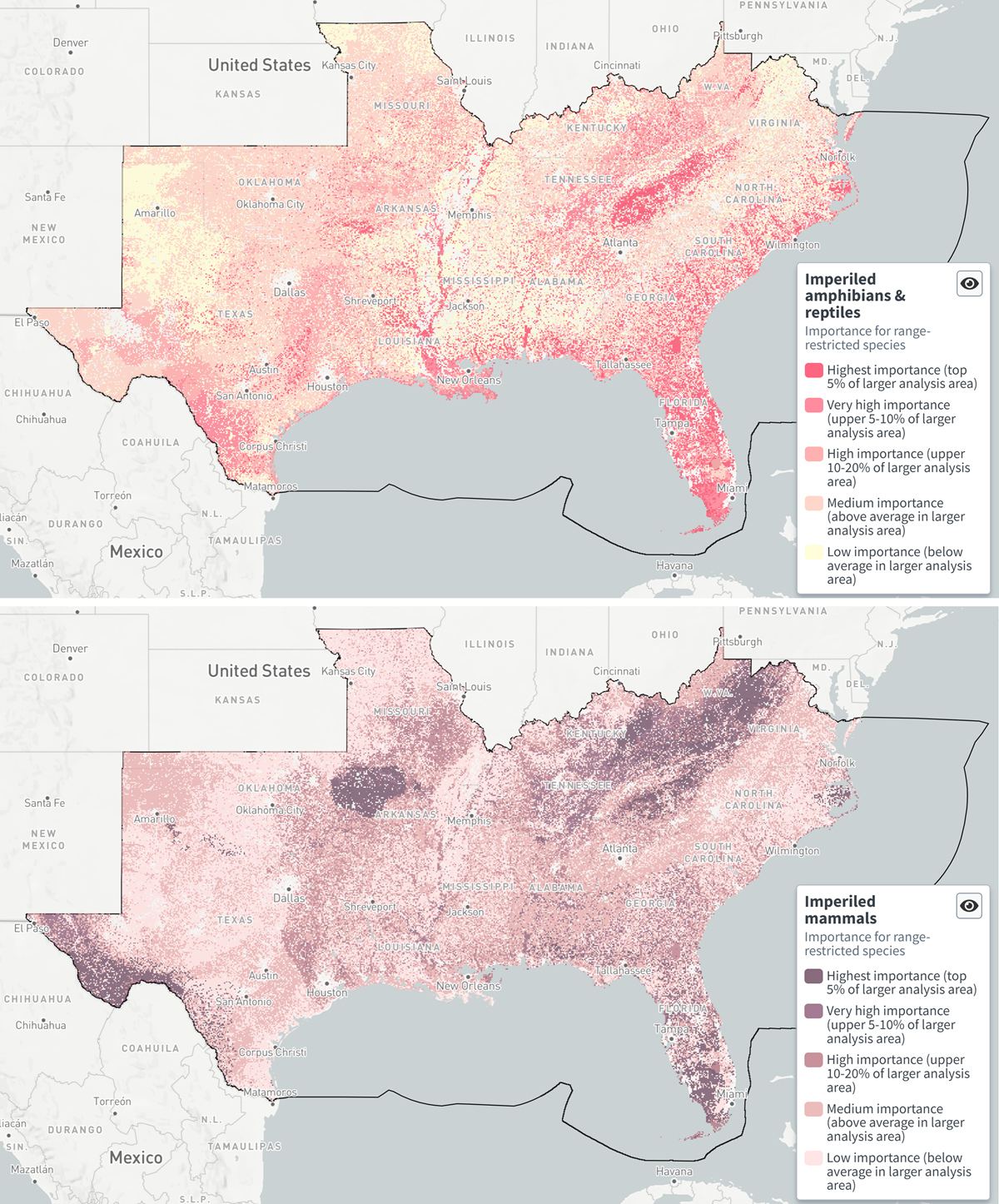
From the beginning, SECAS has focused on scaling local priorities to the regional level while also making sure partners can see themselves, and the places they care about, reflected in conservation planning. Last year, we released the 2025 version of the Southeast Conservation Blueprint and, among the many improvements, we added two new indicators that speak to this: imperiled amphibians and reptiles and imperiled mammals. These spatially explicit indicators represent years of expert knowledge, science, and cross-jurisdictional collaboration.
To better align priorities across boundaries, Southeast state fish and wildlife agencies worked together to compile Regional Species of Greatest Conservation Need (RSGCN) lists for both animals and plants. The Southeast animal RSGCN list includes 960 species across amphibians, birds, bumblebees, fish, invertebrates, mammals, and reptiles—reflecting not only state priorities, but also shared regional conservation values for our wider community. For example, iconic species like the Eastern hellbender and salt marsh sparrow are important for state agencies and for our culture, ecosystems, and shared stewardship.
The imperiled amphibians and reptiles indicator represents approximately 82% of RSGCN species and subspecies, while the imperiled mammals indicator includes 96% of all mammal species on the RSGCN list. Together, these indicators identify potential habitat for hundreds of species, with an emphasis on range-restricted species and narrow endemics that occur in small, often singular places—making them particularly vulnerable to extinction.
These indicators were developed in close collaboration with our state partners through focus groups and indicator teams. Feedback from state wildlife biologists helped ensure we captured places known to be important on the ground.
What I find most exciting about these new indicators is the way they elevate local and statewide priorities to a regional scale. State partners can see what they care about reflected in the Blueprint, while also using it to showcase those priorities, connect with new partners, and unlock new opportunities for conservation action across the Southeast. We welcome you to explore the 2025 Blueprint and dig into how the SECAS partnership can help amplify local priorities. And as always, we appreciate feedback on what we can do better! Feel free to reach out to me at louise_vaughn@fws.gov.
SECAS staff would also like to thank the team at the U.S. Geological Survey Gap Analysis Project for their hard work, especially Steve Williams and Nathan Tarr, who met with state agencies and prioritized the species-habitat models for the Southeast RSGCN list that help inform these indicators.